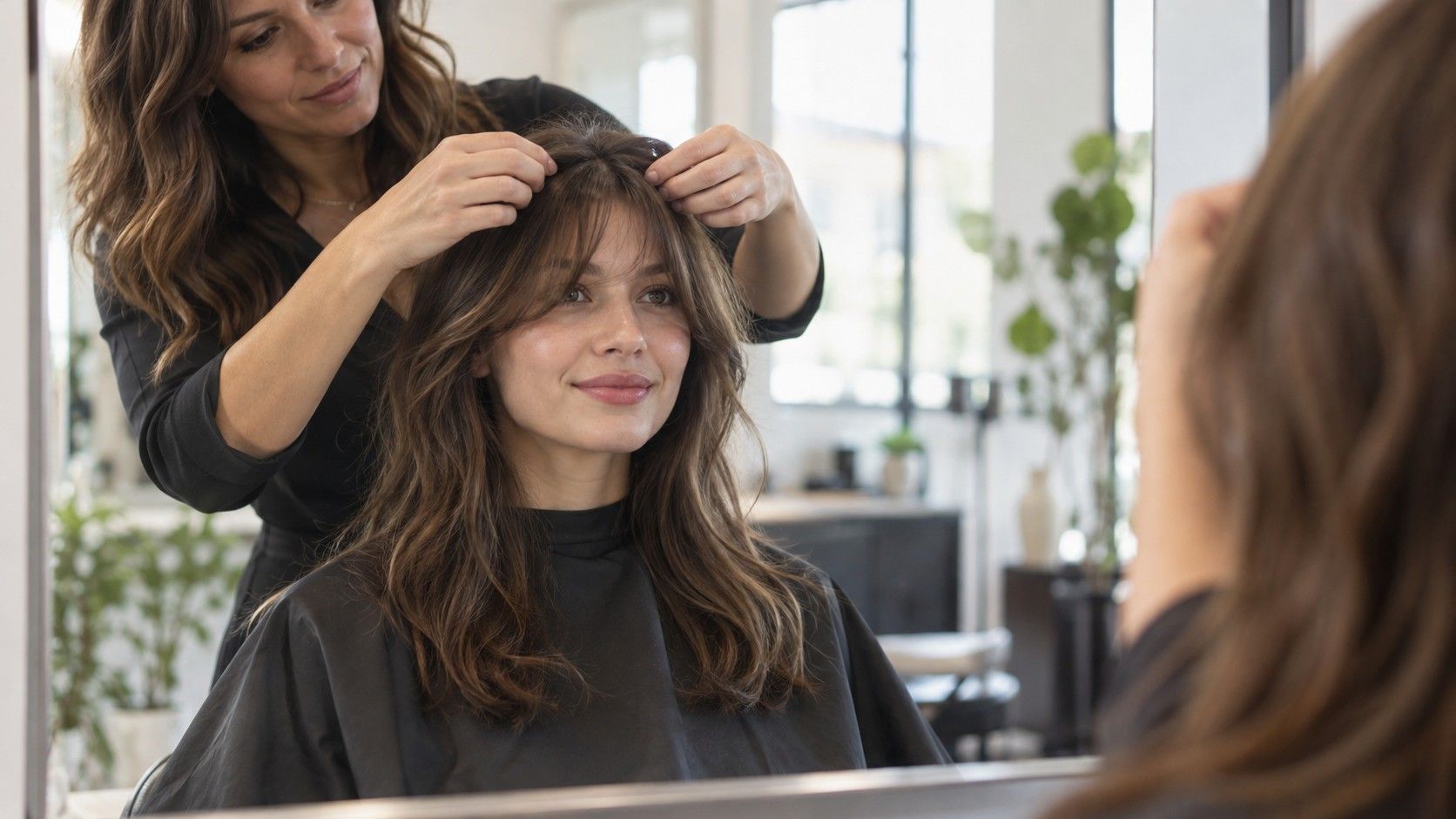
A bob can mean a sharp line at the jaw, a soft shape below the chin or a longer cut brushing the shoulders. Those differences matter more than a chart that assigns one bob to each face shape. Start with where you want the outline to sit, then check what your hair will do at that length. Density, waves, curls and the time you want to spend styling determine whether the photograph you like is a useful reference.
Choose where the bob perimeter should land
The perimeter is the outside edge of the haircut. On a blunt bob, it can make a clear horizontal line; on a softer cut, the edge may look less solid. When that line ends near the chin, it draws attention to that area. A line below the jaw frames a different part of the face. Neither position is automatically right for a round, square or long face. Choose the feature you want the cut to emphasize and the silhouette you enjoy.
Hold a folded scarf or the edge of a towel across the ends of longer hair to suggest different lengths in a mirror. Look with a neutral expression, then turn your head and smile. The exercise will not reproduce the volume or movement of a real cut, but it can reveal whether you prefer an exposed jaw or more hair beside it. Keep the material away from your neck so you can see where the front pieces would actually fall.
Use physical landmarks in the salon: level with the chin, a little below the jaw or clear of the shoulders. “A short bob” leaves too much room for interpretation. Ask whether the proposed length means wet, stretched, freshly blow-dried or naturally dried hair. For waves and curls, those can be visibly different positions.
Consider the back as well as the front. A steep angle from a short nape to long front pieces creates a different outline from an even bob. Bring a side or back reference when that detail matters. If you need to tie your hair up, say so before agreeing to a chin-length cut; a few front pieces that reach a clip do not mean the whole haircut will fit into a ponytail.
Look at width created by texture and weight
The visible width of a bob comes from the hair around the face, not merely the length of its edge. Dense hair with a firm perimeter can create substantial weight at the sides. Fine strands with lower density may produce a lighter outline at the same length. Strand thickness and density are different: you can have many fine hairs, or coarser strands with more space between them. Let the stylist assess both rather than choosing layers from a label alone.
If you want less bulk beside the lower cheeks, discuss where the weight sits when the hair is dry. Removing weight internally may change movement without making every layer visibly short. However, heavy texturizing is not a universal solution. On some hair it creates ends that separate more than you want, exposes sparse areas or changes how the surface settles. Ask what the technique is intended to achieve on your particular hair.
A blunt edge can help fine ends look more continuous, but the outcome depends on density, condition and styling. Shorter layers might create lift near the crown, or they might leave the perimeter lighter than you like. Bring a picture showing the amount of fullness you want, and point to the region concerned. “More movement behind the ear” is a clearer request than “make it flattering.”
Parting also changes the distribution of volume. Try your usual centre or side part during the consultation, then see the proposed outline from the front and profile. If the reference requires a deep side part that you never wear, decide whether that change is welcome. A bob should not depend on fighting a strong parting every morning unless you are comfortable doing that work.
Allow for curls and shrinkage before choosing the final length
Curly and coily hair can sit considerably higher after drying than it does wet or stretched. There is no single amount of shrinkage to subtract from a picture: curl pattern, condition, products and drying method all affect where the ends land. Show the stylist your normal dry shape, ideally before washing or stretching it for the appointment. Explain whether the finished bob should be judged in its natural texture or after a blow-dry.
Different areas may spring up by different amounts. Front pieces can behave differently from the nape, and one side may curl more tightly. An apparently even wet perimeter does not guarantee an even-looking dry outline. Ask how the stylist plans to assess that variation and whether the final shape will be checked after your usual drying method. The answer matters more than a promise that one cutting technique suits every curl.
Wavy hair deserves the same attention. A shorter length can release a wave that was stretched by longer hair, changing both width and the position of the ends. It can also land at a point where the wave bends outward. A photograph of your hair after air-drying offers useful evidence; a picture taken after straightening may hide exactly the behaviour the stylist needs to see.
If you are uncertain about losing length, discuss a staged approach with enough room for a dry check. Starting longer gives you something to adjust, although an intermediate cut still changes the shape and may involve another appointment. Agree on the shortest acceptable dry point near the front. That boundary is more useful than assuming that chin length means the same thing in every state.
Try the cut against your real styling routine
Describe an ordinary morning rather than the routine you hope to adopt. If you wash, apply one product and leave, say that. If you enjoy a round-brush blow-dry, a smooth bob may fit your habits. Ask to see a finish close to what you can reproduce at home. A polished salon result can show the cut beautifully while telling you little about its air-dried behaviour.
Check how the nape, fringe and front pieces respond to your tools. A small brush may be needed for a short back section, while a longer front can require different handling. If a stylist recommends heat, ask which sections need it and how much time to allow. You can then decide whether that effort is acceptable instead of treating daily straightening as an unspoken condition of the haircut.
Bring glasses, hearing devices or the clips you routinely use. Tuck one side behind the ear and see how much fullness collects there. If you work with a headset or need hair secured away from your face, ask what will remain loose at the proposed length. Practical fit checks can change the length choice more decisively than a face-shape label.
Look at your reference for signs of styling: curved-under ends, a very flat crown, deliberate waves or a sharply separated part. Ask which part comes from the cut and which comes from the finish. A bob haircut, hair texture and styling method work together; copying the perimeter alone will not reproduce the whole photograph.
Make the consultation specific and review grow-out
Take two or three references with a specific reason for each. One may show the length, another the softer ends, and another the side view. Include one feature you dislike so the stylist can avoid ambiguity. Photographs of people with similar hair behaviour can be especially useful, but no reference guarantees an identical result on a different head.
State your priorities in order: perhaps a strong jaw-level line matters most, keeping a low ponytail matters next, and daily heat styling is off the table. The stylist can explain which requests work together and where you need to choose. If the consultation becomes a debate over whether your face is oval or heart-shaped, return to the visible decisions: length, side fullness, fringe and how much of the neck you want exposed.
Ask how the outline is likely to change as it grows. A precise short line may need reshaping before a relaxed longer bob would. Hair that approaches the shoulders can start turning outward when it rests against them. Discuss an appointment interval based on the finish you want and your growth, then check the price before committing. There is no universal maintenance calendar for a bob.
Before leaving, learn the smallest routine that supports the intended shape and check the back with a mirror. Notice how the ends sit with your shoulders relaxed and your normal part in place. For a bob, face shape is one observation among several. The stronger decision is a length and weight distribution you like, on hair behaving in a way you can live with between appointments.