Choosing glasses for face shape can give you somewhere to start when a display contains dozens of frames. A rounded rim, a straight brow line or a heavier colour can change what you notice in the mirror. But a style chart cannot tell whether a bridge will stay put, an arm will press behind your ear or a frame will suit your prescription. Treat appearance and eyeglass frame fit as two connected checks, with enough time to wear a promising pair beyond the first photograph.
Start with a bridge that feels settled
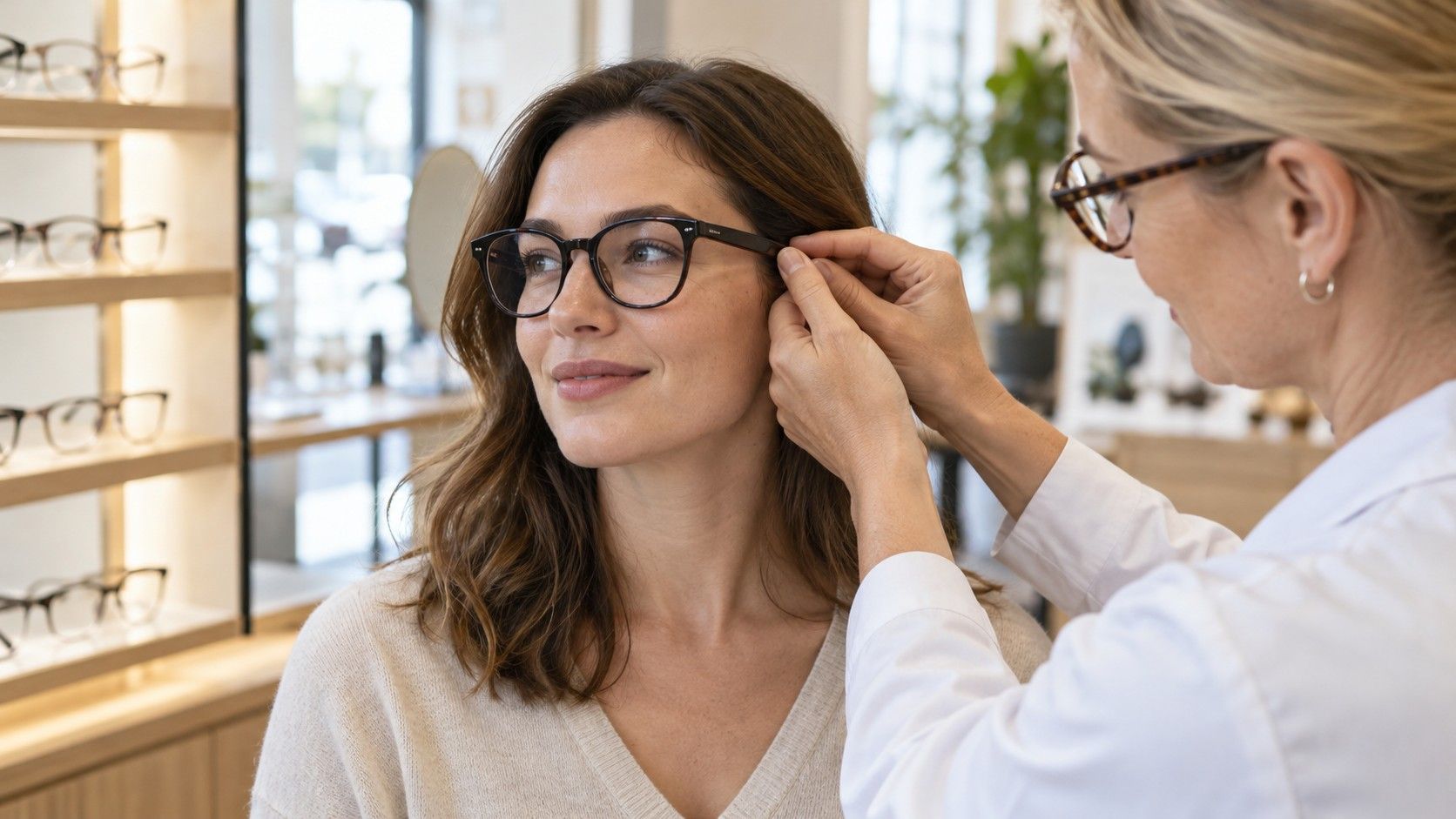
Put the frame on without pushing it into a position it will not hold. Notice the bridge first. It should feel supported and comfortable rather than pinched or precarious. If you keep lifting the frame back up, mention that during the fitting. A pair can look appealing when held at the right height yet settle somewhere else as soon as you let go.
Check the width next. The sides should not squeeze your head, and the frame should not feel loose when you turn naturally. The temples are the arms running back toward your ears; pressure there is a practical fit issue. A face shape label offers little help with this. People with a similar outline can have different nose bridges, head widths and ear positions.
Ask to compare another size or bridge design if the first frame feels wrong. Adjustable nose pads and differently shaped fixed bridges create different contact points, although neither guarantees a fit without trying it. Avoid settling for discomfort because the style is supposedly ideal for an oval or square face. A shortlist is more useful when every pair on it has a plausible route to a comfortable fitting.
Have lens position assessed in the frame you will wear
Look straight ahead in your normal posture and ask the optician to assess how the frame sits around your eyes. The visible position of your pupils can prompt a fit discussion, but you do not need to place them at the geometric centre of every lens opening. The appropriate lens position depends on the prescription, lens design and fitted frame. A mirror check cannot establish that on its own.
Pupillary distance is one of the measurements used in preparing glasses. It does not describe the complete fit of the frame, and it is not a substitute for other measurements that may be needed. Tell the fitter what lenses you are ordering and how you use them. Reading at a desk and wearing glasses through an active day place different practical demands on a pair, even when you like the same style.
Make sure the fitting reflects where the frame actually settles. A measurement taken while you are holding it higher will not describe its usual position. If it slides, rocks or sits unevenly, address that before treating a photograph as proof that everything lines up. The aim is a stable wearing position that a professional can evaluate, with the lens choice taken into account.
Use face shape to compare effects you enjoy
A rounded frame can echo a curved facial outline, while angular corners can create a contrast. Either effect may appeal to you. The familiar advice that a round face must wear rectangles, or a square face must wear circles, turns a preference into a rule. Try the suggested contrast if it interests you, then compare it with a pair that repeats features you already like.
Control the comparison where possible. Try frames of a similar overall width when you are judging corner shape. If one is much larger, darker and thicker, you are comparing several visual changes at once. A bold upper rim may draw your attention upward; a fine rim may feel quieter. Look at the complete combination with your usual hairstyle, because hair can hide the temples or add width beside the frame.
Mixed face shapes do not create a special fitting problem. Describe the feature you want to work with, such as visible cheekbones, a broad forehead or a softly angular jaw. Then choose a trial around that feature. You can like an oversized appearance or a narrow silhouette without treating either as a correction your face needs. Optical suitability and comfort still need to be checked for the actual pair.
| What you are deciding | Useful trial | Separate fit check |
|---|---|---|
| Rounded or angular corners | Compare similarly sized frames | Ask whether each can be fitted comfortably |
| A heavier upper rim | Look with your usual hair and expression | Check whether the frame stays in its fitted position |
| A larger lens outline | View it from the front and side | Confirm suitability for your lens requirements |
| A different bridge design | Wear both without holding them in place | Describe slipping, pressure or uneven support |
Test the pair while you move normally
Spend a little time in the frame rather than deciding from a quick glance. Look down, turn your head gently and smile. Notice if the glasses move with your cheeks, slide down your nose or catch your eyelashes. These observations give the fitter something specific to investigate. Do not deliberately shake the frame hard or bend its arms to create a home test.
Look from the side as well as the front. Check how the arms feel over and behind your ears and whether one area begins to press. If you wear headphones, a helmet or another item alongside glasses, explain that routine and ask how to test the combination. A frame that feels comfortable alone may be less comfortable with equipment pressing against the same area.
Use a photograph to compare appearance if you like, but keep your head position and camera distance similar between pairs. A close selfie can change the apparent relationship between the frame and face. The photo also leaves out weight, pressure and movement. Write a short note for each finalist, such as “like the upper line, slips when looking down,” so that a good picture does not erase a fit concern.
Bring useful measurements, then confirm the whole fitting
If you already own comfortable glasses, bring them along. The numbers printed inside an arm commonly describe lens width, bridge width and temple length. They can help narrow the search, but matching numbers do not guarantee that two frames will feel the same. Bridge contour, material, overall design and the way the arms sit can differ. Use the old pair as a reference to try, not an exact specification to copy.
Explain what works about your current glasses and what does not. Perhaps the bridge stays stable but the arms press under headphones, or the frame feels light but touches your cheeks when you smile. That is more useful than asking for a frame for a particular shape alone. Ask which issues can reasonably be adjusted and which suggest trying another design or size.
Before ordering, confirm that the chosen frame is appropriate for the intended lenses and that the necessary fitting measurements will be taken. Ask what adjustment support is available when the finished glasses arrive. A display frame may feel different from the completed pair, so allow for a final fitting rather than assuming the first try-on settles everything. Leave bending or heating a frame to someone equipped to adjust it.
You can finish with a small shortlist instead of a winning shape category. Keep the frames whose appearance you enjoy, describe any comfort concerns clearly and let the optical fitting resolve questions a style chart cannot answer. A good choice should make sense in the mirror, during ordinary movement and with the lenses you actually need. Those checks give face shape its useful place without asking it to make the entire decision.